
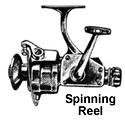
 Spinning:
Spinning rods and reels are very popular because they’re easy
to use, allow long casts with light lures, and can be quite
inexpensive. The first two or three line guides on a spinning
rod are large, because the line “billows” off the end of the
reel spool during the cast. To cast with a spinning reel, you
open the wire “bail” that wraps line around the spool,
holding the line with your index finger. Release the line as you
move the rod forward and with a little practice you’re casting
like a champ. Nylon monofilament line of 6- to 12-pound test
works best on most spinning reels. Spinning:
Spinning rods and reels are very popular because they’re easy
to use, allow long casts with light lures, and can be quite
inexpensive. The first two or three line guides on a spinning
rod are large, because the line “billows” off the end of the
reel spool during the cast. To cast with a spinning reel, you
open the wire “bail” that wraps line around the spool,
holding the line with your index finger. Release the line as you
move the rod forward and with a little practice you’re casting
like a champ. Nylon monofilament line of 6- to 12-pound test
works best on most spinning reels.
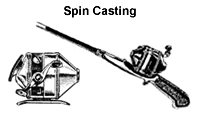
Spin-casting: Like a spinning reel, the
spin-casting reel has a stationary spool, with line leaving and
returning at one end of that spool. But the spool on the
spin-casting reel is enclosed, so you can’t see it. The line
is released by use of a thumb-button at the back of the reel.
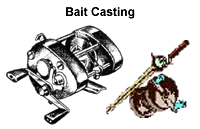 Bait-casting:
These reels differ greatly from both spinning and spin-cast
reels because the spool sits perpendicular (cross-ways) to the
rod rather than parallel to it. Because the spool moves during
casting and retrieving, these reels are often called
revolving-spool reels. Bait-casting tackle requires more
practice, patience and skill than both spinning and spin-casting
tackle, but once mastered, allows for pin-point casting accuracy
and excellent line control when fishing and playing fish. Bait-casting:
These reels differ greatly from both spinning and spin-cast
reels because the spool sits perpendicular (cross-ways) to the
rod rather than parallel to it. Because the spool moves during
casting and retrieving, these reels are often called
revolving-spool reels. Bait-casting tackle requires more
practice, patience and skill than both spinning and spin-casting
tackle, but once mastered, allows for pin-point casting accuracy
and excellent line control when fishing and playing fish.
|